Cards Grapefruit League Offense Trails the Field
The Cardinal Chronicle
Cardinals’ Grapefruit League Offense Trails the Field
St. Louis, MO
By Ray Mileur
Spring training always brings optimism. New philosophies are introduced, adjustments are tested, and every club believes it has taken a step forward during the offseason.
For the St. Louis Cardinals, one of the central themes of camp has been the effort to reshape the offense. The organization has talked openly about building a lineup centered on contact, athleticism, and modern run creation. Two weeks into Grapefruit League play, however, the results have yet to match the vision.
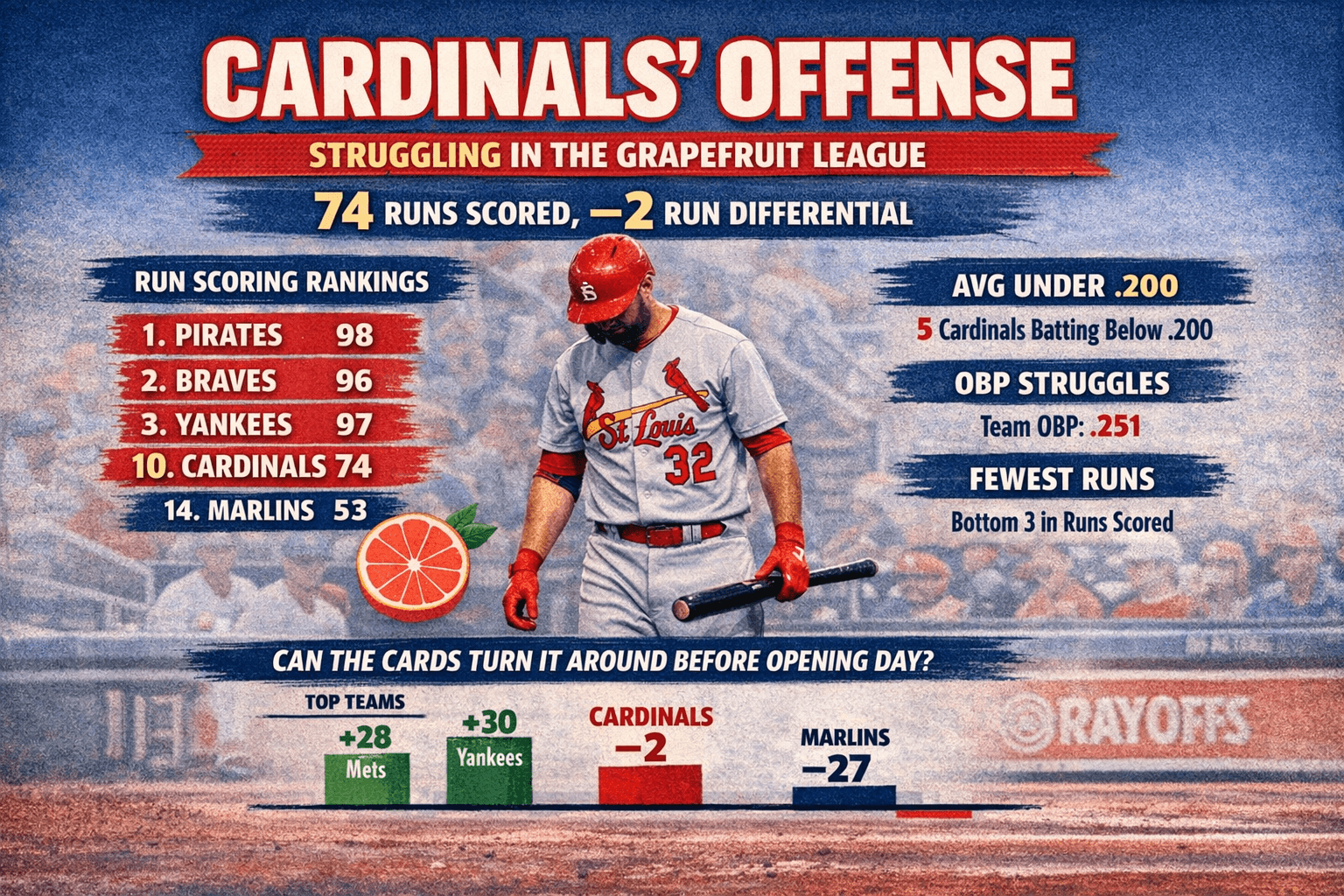
Through the early stretch of games, the Cardinals have scored 74 runs, placing them firmly in the bottom third of the Grapefruit League. While several clubs have surged ahead offensively—Atlanta, Pittsburgh, New York, and Boston have all pushed toward or beyond the 95-run mark—St. Louis remains grouped among a collection of teams still searching for consistent production.
The run differential tells a similar story. At –2, the Cardinals have been competitive most afternoons, but rarely in full control of the game.
Contact Still Elusive
The most visible issue has been simple: too many empty at-bats.
Several expected contributors are hitting below the .200 mark, and the lineup has struggled to put together sustained innings. Spring slumps are common, but the number of them occurring simultaneously has prevented the club from establishing any offensive rhythm.
Too many plate appearances have ended without the ball being put in play, leaving rallies unfinished before they ever truly begin.
There have been occasional signs of power—isolated home runs and extra-base hits scattered across the lineup—but those moments have come as individual bursts rather than sustained pressure.
The Cardinals have yet to see a hitter establish himself as a reliable middle-of-the-order presence this spring, and without consistent traffic on the bases, even well-struck balls have rarely turned into big innings.
The on-base problems is perhaps the most telling statistic in camp has been the club’s on-base percentage. A number of hitters are carrying OBPs in the .220 to .260 range, a difficult foundation for any offense trying to manufacture runs.
Even when a hitter squares up a ball, the Cardinals have too often found themselves doing so with empty bases and limited opportunities to capitalize.
To the club’s credit, much of this spring has been devoted to opportunity and evaluation.
Young players, prospects, and non-roster invitees have received significant playing time as the organization continues to lean into its emerging youth movement. That approach brings energy and potential—but also inconsistency.
From a developmental standpoint, those innings are valuable. From a competitive standpoint, the nightly lineup variations have made it harder to establish continuity.
Perspective still matters, Spring training is not a final verdict on a season. Veterans often use March to work through timing issues, and lineups tend to stabilize as Opening Day approaches.
Still, the early pattern is difficult to ignore. The Cardinals’ offense has yet to find its footing, and compared with the rest of the Grapefruit League, the production gap is noticeable.
The coming weeks will reveal whether this is simply a slow spring adjustment—or the early signal that the club’s offensive transformation may take longer than anticipated.
The Cardinal Chronicle
Preserving the Past, Promoting the Present, and Projecting the Future.